When most operations teams talk about warehouse inventory management, they’re really talking about survival:
“Can we find the right part when we need it?”
“Do the counts in the system match what’s on the shelf?”
“How do we add more SKUs without taking on another lease?”
Early on, simple storage bins for inventory and static shelving work fine. But as order volumes rise and product lines expand, those shelves start to work against you. Travel paths grow longer, bins overflow, and cycle counts become a headache that never really ends.
That’s the turning point where many facilities move from bin shelving to automated storage — and specifically to Vertical Lift Modules (VLMs).
Done right, VLMs don’t just give you more space; they become the inventory control hub of your warehouse, centralizing location management, cycle counting, and high-accuracy picking in a compact footprint.
In this guide, we’ll walk through how VLMs transform managing warehouse inventory, how they fit into your broader storage strategy, and practical steps to go from static shelving to an automated, VLM-centric approach.
Why Traditional Warehouse Inventory Management Starts to Break Down
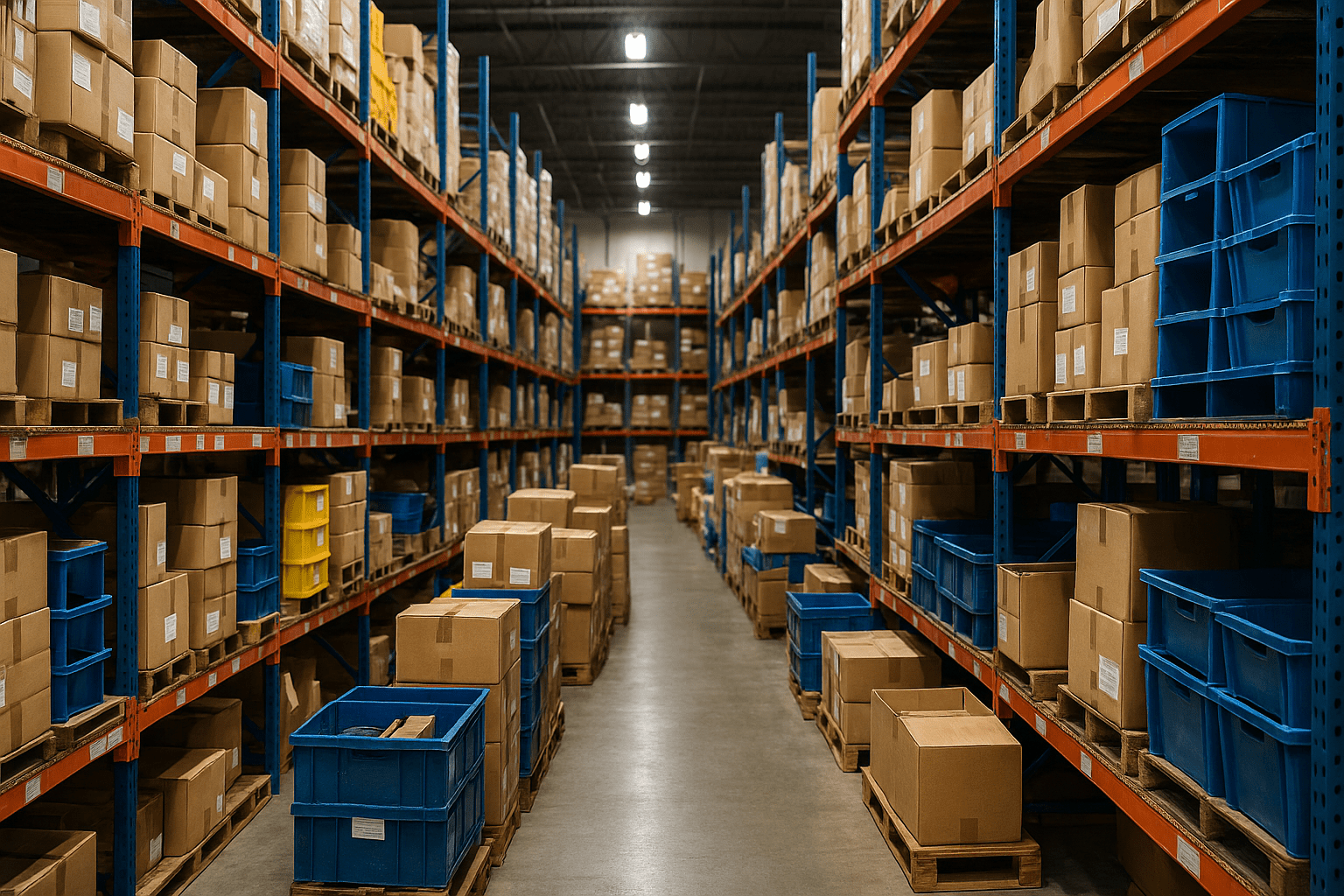
If your facility still relies heavily on static racks and bins, your team is probably fighting at least a few of these issues:
1. Too many locations, not enough control
As SKUs grow, the typical response is to:
Add more aisles
Add more shelves
Add more “temporary” overflow locations
That might solve today’s storage crunch, but it creates a location management problem. The same part number ends up in three different bays, and your WMS or spreadsheet is constantly playing catch-up.
If you’re trying to get your arms around this, stepping back to evaluate your broader warehouse storage solutions is a smart starting point.
2. Inventory accuracy drifts over time
Even with a solid warehouse inventory process, static shelving makes it hard to keep counts accurate:
Open bins invite mispicks and putaways in the wrong slot
Fast movers get “borrowed” from neighboring bins when one runs out
Full-warehouse counts require shutting down or running skeleton crews
You can improve the layout, labeling, and inventory storage solutions, but eventually the limits of a purely manual environment show up in your KPIs.
3. Space constraints squeeze operations
Static racks are great at taking up floor space. They’re not so great at using the vertical cube of your building. As you grow:
Aisles get narrower and harder to navigate
Safety and ergonomics suffer
You start thinking about adding a mezzanine or taking on another facility
High-density, automated options like VLMs and vertical storage systems attack all three issues at once: inventory control, accuracy, and space utilization.
What a Vertical Lift Module Does for Warehouse Inventory Management
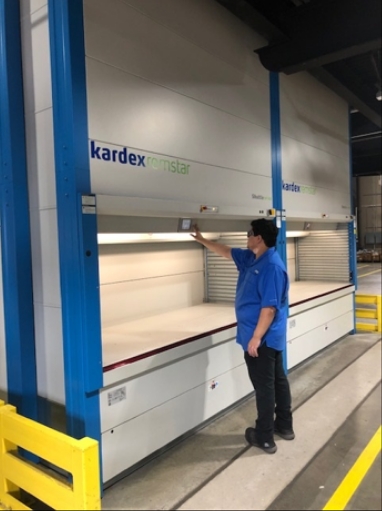
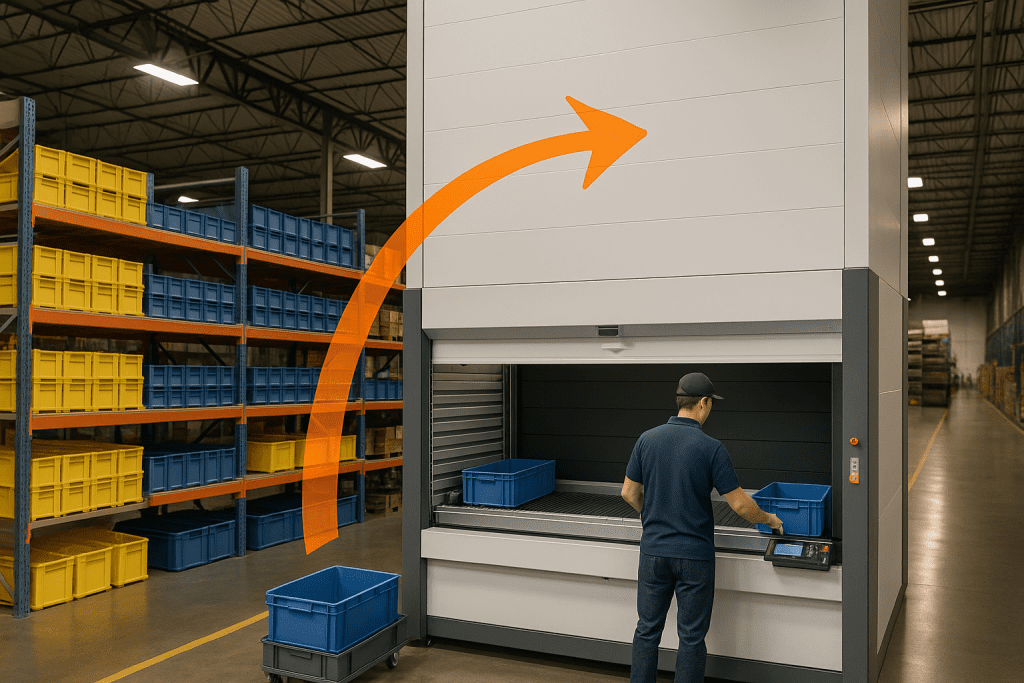
A Vertical Lift Module is an automated storage system that stores items in trays, stacked vertically between two columns. An internal lift moves up and down to retrieve the correct tray and delivers it to an ergonomic access opening for the operator.
From an inventory-management standpoint, here’s why that matters.
1. Every item has a defined, system-controlled location
In a VLM, you don’t have “somewhere on that rack” locations anymore. Each part is assigned to:
A specific tray
A specific position in that tray
A system-controlled location in the machine
Your WMS or VLM controller knows exactly where each SKU lives, what quantity is on hand, and which transactions have occurred. Instead of chasing labels in the aisle, operators scan at the access opening and let the machine bring the part to them.
If you’re exploring what this looks like in more detail, your Vertical Lift Modules page is a natural place to send prospects who want a deeper technical overview.
2. Space utilization improves automatically
VLMs significantly compress storage by:
Using the full building height
Dynamically optimizing tray positions based on height
Storing slow movers tightly while keeping fast movers accessible
This is especially powerful when you integrate VLMs into a broader plan that might also include mobile aisle storage systems for pallets or bulk storage and warehouse storage solutions for small items for the rest of your SKU mix.
The result: 30–90% space savings compared to static shelving storing the same inventory profiles.
3. Built-in tools for cycle counting and accuracy
Because the system knows exactly what should be on each tray, VLMs are ideal for cycle counting without disrupting operations:
Operators can trigger counts by tray, by SKU, or by zone
Counts can be woven into normal picking workflows
Any variance is immediately flagged in the software
When you’re explaining how to manage inventory in a warehouse, shifting the mindset from “full-warehouse physical counts” to “continuous cycle counting inside automated systems” is a major cultural and process win.
From Bin Shelving to VLMs: Designing a New Inventory Flow
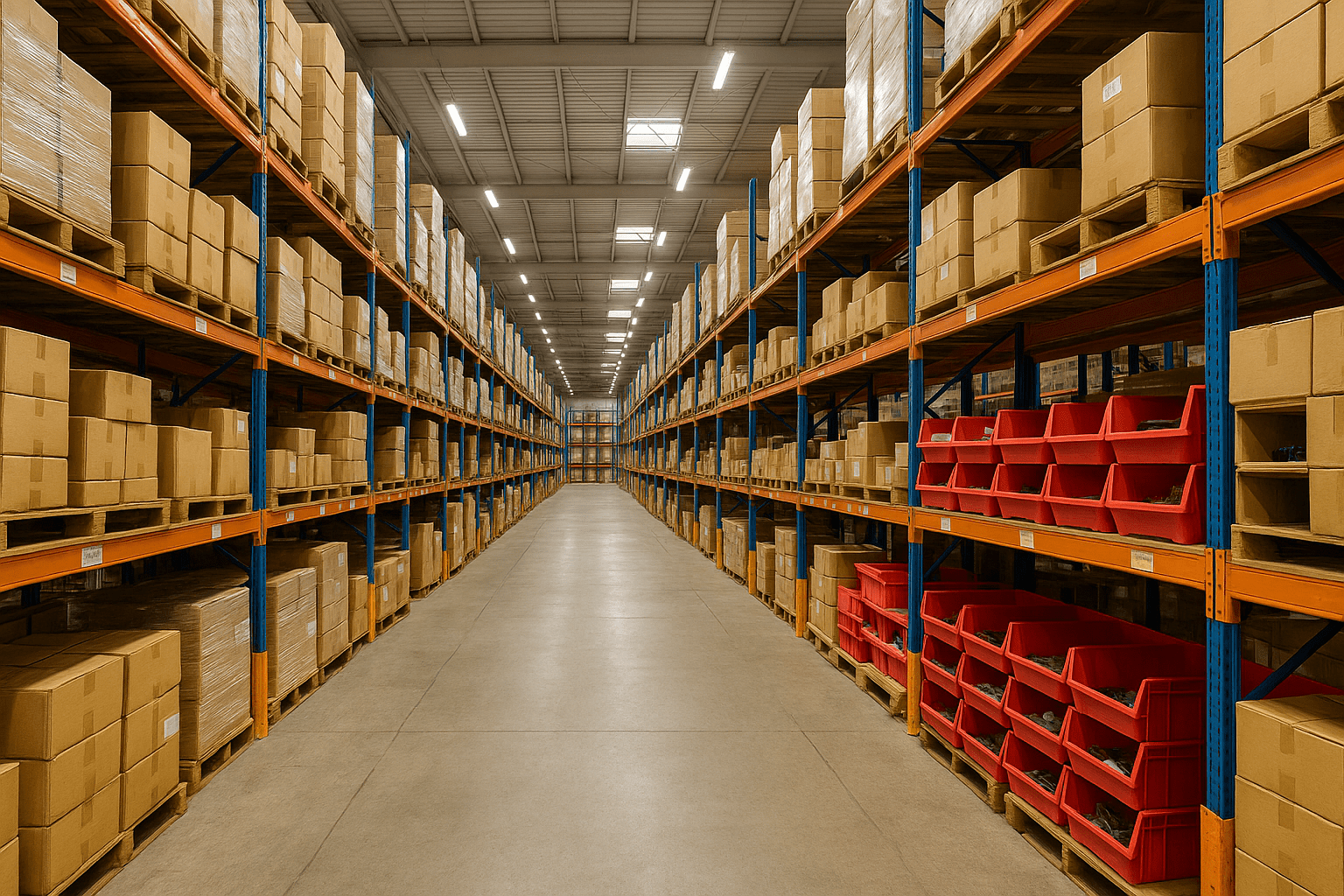
If your current environment looks like a sea of shelving, the path to VLM-centric inventory warehouse management usually follows a phased approach.
Step 1: Identify the right SKU profiles
VLMs deliver the most value when they’re storing:
Small to medium parts and components
High-value or secure items
Fast-moving, high-touch SKUs that are picked frequently
Start by doing a Pareto analysis — the classic 80/20 rule. Which 20% of SKUs account for 80% of activity? Those are prime candidates to migrate from storage bins for inventory to an automated system.
For customers comparing approaches, you can reference your existing article “Warehouse Inventory Management: From Bin Shelving to Goods-to-Person” as a complementary resource that shows how VLMs fit into a larger G2P strategy.
Step 2: Map the transition to automated storage
Once you’ve chosen your initial SKU set, you can:
Slot SKUs into VLM trays based on size, velocity, and family grouping.
Define new pick paths where VLMs handle the highest-value or most frequently picked parts.
Convert freed-up shelving areas to bulk, pallet, or oversize storage.
In many facilities, the VLMs become the “primary pick face” while traditional racking handles pallets and case-level storage. For operations moving toward a fully automated system, VLMs can also serve as the dense storage layer below a RackBot AS/RS or other G2P technology.
Step 3: Integrate software and data
To maximize the inventory-management benefits, your VLMs should be tightly integrated with:
WMS / ERP
Inventory management software
Pick-to-light or RF devices
This is where an automated storage and retrieval system approach really pays off. Instead of juggling spreadsheet adjustments and manual corrections, every VLM transaction — picks, putaways, moves, counts — becomes part of your real-time warehouse inventory picture.
For prospects thinking beyond just one type of machine, you can also point them to your AS/RS systems overview and automated warehousing solutions pages to see how VLMs fit into a full automation roadmap.
How VLMs Improve Daily Warehouse Inventory Management
Once your VLMs are live and integrated, the day-to-day experience of managing warehouse inventory looks very different from a bin-shelving environment.
1. Faster, more accurate picking
Instead of walking aisles, operators:
Receive a pick list on a screen or RF device
Scan or confirm the order
Watch as the VLM automatically retrieves each tray in sequence
Light indicators or on-screen prompts show the exact pick location on the tray, and each pick is confirmed by barcode or scan. This dramatically cuts mispicks and speeds up throughput.
For high-SKU count environments — especially small parts, service items, or spare-parts rooms — this is a major upgrade over traditional inventory storage systems.
2. Simpler putaway and replenishment
Putaway is where many inventory errors happen: wrong shelf, wrong bin, or wrong quantity. With VLMs:
The system selects a tray location based on space and SKU rules
The lift brings that tray to the operator
The operator confirms quantity and SKU at the access opening
The result: cleaner data, fewer misplaced items, and less time hunting for “ghost” inventory that exists in the system but not in reality.
3. Continuous inventory control, not occasional fire drills
Because every transaction is tracked inside the machine, inventory teams can:
Schedule cycle counts by ABC class or by machine
Reconcile variances before they turn into order issues
Drill into specific SKUs or trays when discrepancies occur
For leaders focused on warehouse inventory management KPIs, VLMs make it easier to hit targets for inventory accuracy, lines picked per hour, and order fill rates — without blowing up labor budgets.
Where VLMs Fit with the Rest of Your Storage Strategy
A VLM-centric inventory strategy doesn’t mean everything moves into a tower. It means you’re using the right tools for each storage and handling challenge.
Here’s how VLMs typically sit alongside other systems:
Carousels and small-parts automation
In some operations, you’ll find VLMs working alongside vertical carousels and horizontal carousels. Carousels are excellent for certain part profiles and pick patterns; VLMs offer greater flexibility with tray height optimization and mixed SKUs.Mobile storage and bulk storage
Palletized goods, long loads, or bulk materials might be better served by mobile storage solutions and conventional racking. VLMs then handle small parts, fast movers, and high-value items in a compressed footprint.Cold storage and special environments
For companies managing temperature-controlled SKUs, integrating dense automation and cold storage solutions can dramatically reduce energy costs per item stored while improving accuracy and security.Used equipment and phased investment
For operations wanting a lower initial investment, used equipment and systems — including pre-owned VLMs and carousels — can be a smart entry point into automated inventory control.
Seen together, these systems create a layered solution where each technology plays to its strengths and supports a unified warehouse inventory management strategy.
Key Metrics to Track in a VLM-Centric Inventory Operation
As you transition from static shelving to VLMs, it’s worth updating which metrics you track and how you measure success. Common KPIs include:
Inventory accuracy (%):
How closely do on-hand counts in the system match physical counts inside the VLM?Lines picked per hour (LPPH):
Measure before and after VLM implementation to quantify labor savings and throughput gains.Space utilization (% of cube):
Track the footprint and cubic usage of former shelving areas versus the new VLM footprint.Order cycle time:
How long does it take from order release to pick complete when VLMs serve as the primary pick face?Labor per order or per line:
With travel time sharply reduced, you should see a measurable drop in labor needed to support the same (or higher) volume.
Pulling these results together with data from your WMS, VLM software, and broader inventory storage solutions helps build the business case for expanding automation to other areas of the warehouse.
Getting Started: How to Manage Inventory in a Warehouse with VLMs at the Center
If you’re evaluating how VLMs might reshape your warehouse inventory management, here’s a practical starting checklist:
Audit current inventory
Identify SKU counts, dimensions, and velocity
Flag high-value, high-touch, or security-sensitive items
Define your target VLM inventory
Choose an initial set of SKUs to migrate into one or more VLMs
Group by family, velocity, or customer program
Evaluate your space and layout
Identify where VLMs would live in your vertical warehouse storage footprint
Consider how they connect to receiving, kitting, and shipping
Align software and processes
Make sure your WMS, ERP, or inventory tools can integrate to VLM controls or AS/RS systems
Update SOPs for picking, putaway, and cycle counting around the new workflows
Model ROI and growth path
Compare VLM investment to expansion, relocation, or mezzanine options
Look at not just space savings, but labor, accuracy, and throughput gains
For operations leaders who want hard numbers, pointing readers toward your vertical lift module price and cost breakdown page is a natural next step. It helps bridge the gap between “this sounds good in theory” and “here’s what it would actually cost us.”
FAQ: Warehouse Inventory Management With Vertical Lift Modules
1. What is a Vertical Lift Module (VLM)?
A Vertical Lift Module (VLM) is an automated storage and retrieval machine that stores items in trays stacked vertically. An internal lift automatically retrieves the correct tray and delivers it to an ergonomic access opening, improving accuracy, space utilization, and picking efficiency.
2. How do VLMs improve warehouse inventory management?
VLMs centralize SKU locations, enforce system-controlled putaway, speed up picking, reduce walking, and make cycle counting easier. They also eliminate bin overflow and misplacements common with traditional shelving.
3. Can VLMs integrate with my WMS or ERP system?
Yes. VLMs can integrate with most modern WMS/ERP platforms so every pick, putaway, and cycle count is tracked in real time. This is key when upgrading from manual processes to automated warehouse inventory management workflows.
4. What types of inventory should be stored in a VLM?
VLMs are ideal for:
Small to medium-sized parts
High-value or secure items
Fast-moving SKUs
Spare parts, components, service items, and kits
Slow-moving, bulky goods are usually kept in pallet racking or mobile storage systems instead.
Final Thoughts: Turning VLMs into the Inventory Control Hub of Your Warehouse
The real shift in warehouse inventory management isn’t just swapping shelves for machines. It’s treating dense, automated vertical storage as the central nervous system of your inventory strategy.
When VLMs are fully integrated into your layout, your software, and your daily processes, you get:
Fewer locations to manage
Higher inventory accuracy
Less walking and searching
Better use of your existing building
Clear data to drive future automation decisions
From there, it’s much easier to layer on additional systems — from vertical carousels and horizontal carousels to AS/RS and G2P robots — knowing that the core of your inventory is under tight, automated control.
If you’re ready to move beyond bin shelving and manual counts, positioning VLMs as the heart of your warehouse inventory strategy is one of the most powerful steps you can take.