In today’s high-demand logistics environment, automated storage is no longer an optional upgrade — it’s the backbone of modern warehouse efficiency. As labor costs rise and square footage becomes more expensive, companies are turning to vertical lift storage modules (VLMs) and other automated storage and retrieval systems (ASRS) to stay competitive. Each Modula vertical lift module operates as a fully automated system, managing storage and retrieval without manual searching.
The Modula vertical lift module is one of the most advanced automated storage solutions available today. As part of a broader family of vertical lift modules (VLMs), it helps warehouses reduce floor space, increase throughput, and create a fully automated picking and storage process.
But not all VLMs are built the same. From global brands like Kardex and Modula, to more specialized providers like Hänel and Vidir, this guide breaks down the key differences, advantages, and applications of today’s top automated storage technologies.
🔍 What Is Automated Storage?
Automated storage refers to systems that use computer-controlled mechanisms to automatically store and retrieve items. These solutions minimize manual labor, reduce picking time, and maximize available warehouse space. The most common form in space-constrained environments? The Vertical Lift Module.
What Is a VLM?
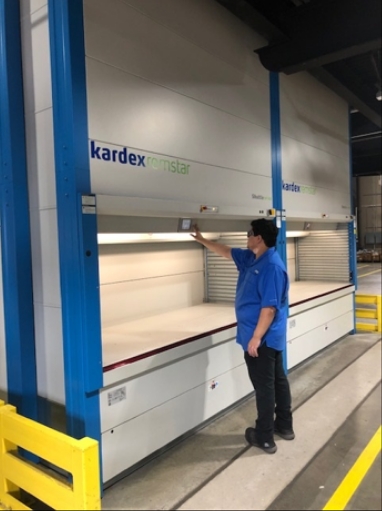
A Vertical Lift Module (VLM) is a type of automated storage solution that vertically organizes trays in two columns. A central extractor automatically retrieves items and delivers them to the operator at an ergonomic access point. This “goods-to-person” method reduces walking, improves pick accuracy, and significantly cuts down on wasted space. Vertical lift modules (VLMs) are the backbone of many modern automated storage systems, automating both picking and storage functions to reduce travel time and maximize vertical cube utilization.
Benefits of VLMs and Automated Storage
Vertical Lift Modules and other automated storage solutions offer a range of measurable benefits that go far beyond saving space. One of the most significant advantages is how much vertical real estate they reclaim. Instead of relying on traditional shelving that eats up valuable floor space, VLMs use ceiling height — often recovering up to 90% of the area currently occupied by shelving or racking.
In terms of efficiency, automated storage reduces the time employees spend walking aisles, searching for parts, or using ladders and lifts. This directly improves pick rates and throughput, allowing facilities to fulfill more orders with the same—or even fewer—staff.
Accuracy is another major win. With software-driven systems managing inventory, the likelihood of mispicks and inventory errors is drastically reduced. These systems also integrate with warehouse management software (WMS), enabling real-time inventory visibility and better stock control.
From a safety and ergonomics perspective, VLMs are designed to bring items directly to the operator at a comfortable working height. This minimizes the risk of injuries from bending, reaching, or climbing—common hazards in traditional warehouse setups.
Finally, automated storage systems offer better inventory security. Access can be restricted via login credentials or ID badges, and activity can be tracked for auditing purposes, making it ideal for storing high-value, sensitive, or regulated items.
Modula Lift Pricing vs. Other Warehouse Storage Solutions
When evaluating Modula Lift systems, it helps to compare their pricing and ROI against more traditional warehouse storage options.
Typical Modula Lift price range
A single Modula Lift unit often falls in the $75,000–$150,000+ range, depending on height, tray count, load capacity, software options, and customizations.
Total project cost (including installation and software) can be higher, but many facilities see payback in 18–24 months through space savings and labor reduction.
Versus pallet racking and static shelving
Upfront cost: Pallet racking and shelving are cheaper per square foot, but they use far more floor space.
Space & labor: A Modula Lift can recover up to 90% of floor space and cut walking time dramatically, often enabling the same throughput with fewer people.
Best fit: Static racking is best for bulk pallets and low-mix storage; Modula shines with high-SKU, small-parts, and intensive picking operations.
Versus mezzanines and building expansions
Upfront cost: Building a mezzanine or expanding your facility can require six-figure to seven-figure investments plus permits and long timelines.
Space efficiency: A Modula system uses height more efficiently and doesn’t require as much structural work, making it a faster and often cheaper way to add usable storage capacity.
Best fit: Mezzanines add floor area; Modula provides both storage density and automation in the same footprint.
Versus other automated storage solutions (shuttles, cranes, large AS/RS)
Complexity & cost: Full-scale shuttle or crane-based AS/RS systems can reach $1M+ and require significant engineering and integration.
Modularity: Modula Lift offers a more modular, scalable approach that can be installed one unit at a time and expanded as demand grows.
Best fit: Large, high-throughput DCs may justify big AS/RS projects, while Modula is ideal for single facilities, regional warehouses, or focused automation projects.
For many operations, Modula Lift pricing sits in the sweet spot: higher than basic racking, but far lower and more flexible than full-scale AS/RS projects—while still delivering major gains in space, labor efficiency, and accuracy.
Comparing the Top VLM Brands: Modula vs. Kardex vs. Hänel vs. Vidir
Let’s compare the key players in the VLM and automated storage space, so you can decide which solution makes sense for your facility. The Modula Vertical Lift line includes the Lift, Slim, and OnePick models, all engineered for modular scalability and precision. Available tray widths range from 59 to 161 inches, customizable for part size and load, and the intuitive Copilot Console offers touch-screen control with integrated diagnostics.
| Feature | Modula | Kardex Remstar | Hänel | Vidir |
|---|---|---|---|---|
| Origin | USA & Italy | Germany | Germany | Canada |
| Flagship Products | Modula Lift, Modula Slim | Shuttle XP, Megamat RS | Lean-Lift, Rotomat | Vertical Modules, Pan Carousel |
| Max Tray Load Capacity | Up to 2,200 lbs | Up to 1,000 lbs | Up to 1,000 lbs | Varies |
| Max Height | Up to 52 ft | Up to 75 ft | Up to 66 ft | Custom |
| Software Integration | Modula WMS, ERP-ready | PowerPick Global, SAP plugins | HänelSoft®, SAP certified | Custom API, 3rd-party friendly |
| Notable Industries | Automotive, Aerospace, MRO | Pharma, Distribution, E-Comm | Hospitals, Labs, Defense | Print, Tire, Retail |
| US Support Network | Strong local install teams | Global service reach | Regional reps & dealers | Niche reseller network |
| Ideal Use Case | High-speed order picking | High-density, large inventory | Secure, clean environments | Oversized vertical storage |
Operators appreciate the user-friendly interface and ergonomic picking bay design of Modula systems, which speed up throughput in busy facilities.
Comparing Hänel Storage Solutions With Other Brands
Hänel, Modula, Kardex, and Vidir are all major players in automated vertical storage, but each brand has its sweet spot.
Hänel storage solutions (like the Lean-Lift® and Rotomat® vertical carousels) are known for:
Strong performance in clean, controlled environments such as hospitals, labs, and defense facilities
Tight integration with audit trails and compliance requirements (for regulated industries)
Smooth, quiet operation and refined ergonomics for office and healthcare settings
Compared to other brands:
Modula focuses heavily on high-throughput order picking and broad industrial applications, with strong U.S. support and flexible configurations for manufacturing, MRO, and distribution.
Kardex Remstar shines in large, multi-site operations that need deep software integrations and high-density storage across complex distribution networks.
Vidir specializes in niche vertical storage for long, bulky, or rolled goods (like tires, print media, and building materials), where standard VLM trays may not be ideal.
SSI Schaefer (another key ASRS provider) offers highly engineered systems—such as shuttles and crane-based AS/RS—for very high-volume, pallet-level or tote-based storage, often used in large distribution centers.
In short, Hänel storage solutions are often the best fit when cleanliness, traceability, and controlled access are top priorities, while Modula, Kardex, Vidir, and SSI Schaefer cover broader industrial, high-density, or pallet/tote-based automation use cases. At Vertical Storage USA, we help you decide which technology fits your space, inventory profile, and compliance needs.
Real-World Applications by Industry
Automated storage solutions aren’t one-size-fits-all. Modula VLMs are widely used across manufacturing, MRO, and aerospace sectors because of their reliability, service network, and ease of integration. Here’s how different industries use VLMs to solve space, speed, and labor challenges:
Manufacturing & MRO
Modula and Kardex are popular in facilities storing spare parts and tools. Fast access and tight inventory control reduce downtime.
Automotive
Dealerships use Modula Lift or Hänel Lean-Lift for organizing small parts, filters, and tools within compact service areas.
Healthcare & Pharmaceuticals
Kardex Shuttle XP and Hänel Rotomat are favored for their cleanroom compatibility and FDA-traceable inventory management.
Libraries, Offices & Archives
Hänel and Vidir solutions are ideal for vertical filing of documents, textiles, or archival items where space and security matter.
Print, Tire & Retail Storage
Vidir offers specialty storage for tires, signage, rolls of print media, and other bulky items requiring vertical access.
🧠 Choosing the Right VLM: Questions to Ask
How much vertical clearance does your facility offer?
Do you need integration with existing ERP or WMS systems?
What tray capacity and dimensions do you need?
Is inventory security or compliance a priority?
How fast do you need installation and support response?
👉 For example:
If you’re in Florida, need fast turnaround, and want a U.S.-based support team — Modula may be the best fit.
If you’re dealing with high-volume SKU management across multiple sites, Kardex offers robust integrations.
If cleanliness or audit trails matter (like in medical or defense), Hänel shines.
When evaluating systems, pay attention to tray width, picking bay configuration, and control options such as the Modula Copilot Console. A wide range of sizes and capacities makes Modula ideal for both compact service areas and large industrial plants, ensuring each solution fits the available footprint.
❓ Frequently Asked Questions
🔹 Are vertical lift modules expensive?
They can range from $75K to $150K+, depending on height, tray count, software, and customizations. However, they often pay for themselves within 18–24 months through space and labor savings.
🔹 What maintenance is required?
Most brands offer annual service contracts. Systems like Modula and Kardex are built for 24/7 reliability with minimal maintenance.
🔹 Can VLMs integrate with my current inventory software?
Yes. Brands like Modula, Kardex, and Hänel offer robust WMS/ERP integrations and APIs. This ensures real-time stock control.
🔹 What’s the difference between a VLM and a vertical carousel?
Vertical carousels rotate trays around a track (like a Ferris wheel), while VLMs use a central extractor. VLMs are more flexible for height and tray customization.
📈 Why Now Is the Time to Invest in Automated Storage
The benefits of automated storage aren’t theoretical anymore. They’re measurable:
Up to 2.5x productivity increase in pick rates
Up to 90% space savings compared to static shelving
Up to 30% fewer inventory errors
Fewer injuries and ergonomic claims
And with ongoing labor shortages and rising lease costs, automating storage is one of the most ROI-friendly moves a warehouse can make.
📞 Ready to Optimize Your Facility?
At Vertical Storage USA, we help businesses across the U.S. choose the right VLM system based on their footprint, inventory profile, and growth goals. We offer:
✔ Free space analysis & CAD layout
✔ Quick quotes on new and used Modula systems
✔ Nationwide delivery & installation
👉 Get a Free Quote Today »
Or call us at (407) 695-5545 to speak with an expert.