When warehouse leaders are asked to move more orders without adding labor, the conversation almost always comes back to warehouse picking. Picking typically accounts for the largest portion of direct labor in a facility, and even small inefficiencies compound quickly across thousands of picks per day.
What often surprises teams is that pick rates usually aren’t limited by how fast employees work. They’re limited by how far employees walk, how often they stop to search or verify locations, and how frequently exceptions interrupt otherwise smooth pick paths. That’s why many organizations start improving pick performance by stepping back and reviewing their broader warehouse optimization strategy rather than immediately adding headcount or new technology.
Increasing picks per hour without hiring is less about pushing people harder and more about removing friction from the process.
Reduce walking by re-slotting fast movers
In most warehouses, walking consumes more time than the physical act of picking itself. When high-velocity SKUs are spread across long aisles or stored in inefficient locations, pickers spend valuable minutes traveling instead of picking. Re-slotting fast movers closer to pack-out areas and placing them at ergonomic heights is often the fastest way to see immediate improvement.
These changes typically surface when teams evaluate their warehouse layout and design and identify unnecessary travel paths created over time as SKU counts expanded. Facilities that struggle with congestion or long pick routes often uncover additional gains by pairing re-slotting with targeted warehouse space optimization, allowing them to fit more pick faces into high-value zones without expanding the building.
Over time, organizations that treat slotting as an ongoing discipline rather than a one-time project consistently outperform those that leave product placement static.
Standardize pick paths to eliminate wasted motion
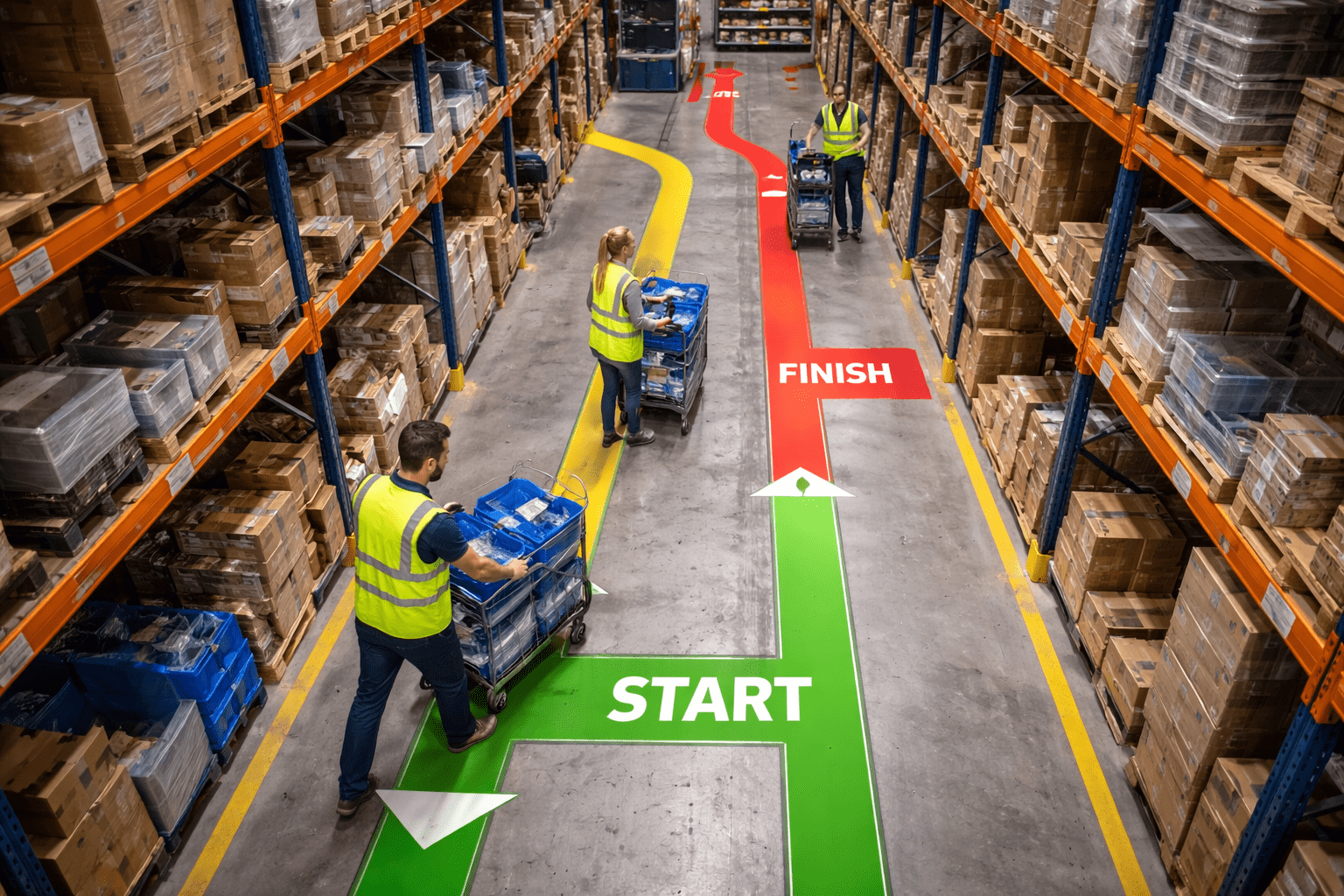
Even skilled pickers lose time when routes aren’t predictable. When every associate chooses their own path through the warehouse, congestion increases and backtracking becomes inevitable. Standardized pick paths simplify decision-making and keep traffic flowing consistently.
These improvements often emerge during broader warehousing design layout initiatives, where aisle direction, cross-aisle placement, and zone sequencing are evaluated together. When pickers know exactly where to start, where to turn, and where to finish, each pick becomes faster—not because people rush, but because the system removes unnecessary choices.
Over hundreds of orders per shift, these small time savings quickly add up.
Apply batch picking where order profiles support it
For warehouses handling a high volume of small or overlapping orders, batch picking can dramatically increase productivity. Instead of sending pickers down the same aisles repeatedly for individual orders, batch picking allows multiple orders to be collected in a single pass and sorted afterward.
This strategy works best when supported by clearly defined processes and consistent training. Many facilities introduce batch picking as part of broader improvements to warehouse processes and procedures and align it with established warehouse management best practices.
When implemented correctly, batch picking reduces travel time without sacrificing accuracy, particularly in environments with predictable order profiles.
Minimize search time through better organization and visibility
Pickers shouldn’t need to stop and confirm whether they’re in the right location. Poor labeling, inconsistent bin numbering, and look-alike SKUs all introduce hesitation that slows picking down. Improving organization and visual clarity reduces cognitive load and allows pickers to move with confidence.
Facilities often address this during broader warehouse organization efforts, where location labeling, signage, and storage consistency are standardized. When locations are intuitive and easy to verify at a glance, pickers maintain momentum instead of pausing to double-check details.
This improvement alone can quietly add significant throughput without changing staffing levels.
Separate forward pick locations from reserve storage
One of the most common causes of congestion in picking zones is shared space between pickers and replenishment activity. When forklifts or pallet jacks frequently enter pick aisles to restock reserve inventory, pick rates suffer.
Separating forward pick locations from reserve storage reduces interference and keeps pick paths clear. Many warehouses accomplish this by redesigning bulk storage with high-density pallet racking while maintaining forward pick faces closer to shipping and packing operations.
As facilities grow, reassessing overall racking and shelving systems often reveals opportunities to increase reserve density while protecting the speed of picking zones. Selective pallet racking remains a common choice for predictable replenishment workflows, particularly when paired with disciplined inventory management.
Reduce exceptions by improving inventory accuracy
Few things slow warehouse picking more than exceptions. Empty locations, mis-located inventory, and receiving errors force pickers to stop, escalate issues, and often retrace their steps. These disruptions consume far more time than normal picks.
Improving accuracy starts with stronger inventory management storage solutions and is reinforced by dependable inventory management software that supports cycle counting, traceability, and real-time visibility. When inventory data is trusted, pickers move faster because they don’t need to question the system.
Over time, reducing exception rates can have as much impact on picks per hour as layout changes.
Increase confirmation speed with pick-to-light systems
In dense picking environments, especially for small parts, confirmation time can quietly erode productivity. Pick-to-light systems guide operators directly to the correct location and quantity, removing the need for scanning or manual verification.
Facilities often explore pick-to-light systems as a way to improve speed and accuracy simultaneously, especially when training new employees or supporting high order volumes. Because lights provide immediate feedback, error rates drop while pickers maintain a steady pace.
For many warehouses, pick-to-light serves as an effective bridge between manual picking and more advanced automation.
Consolidate inventory with vertical storage to shrink travel distance
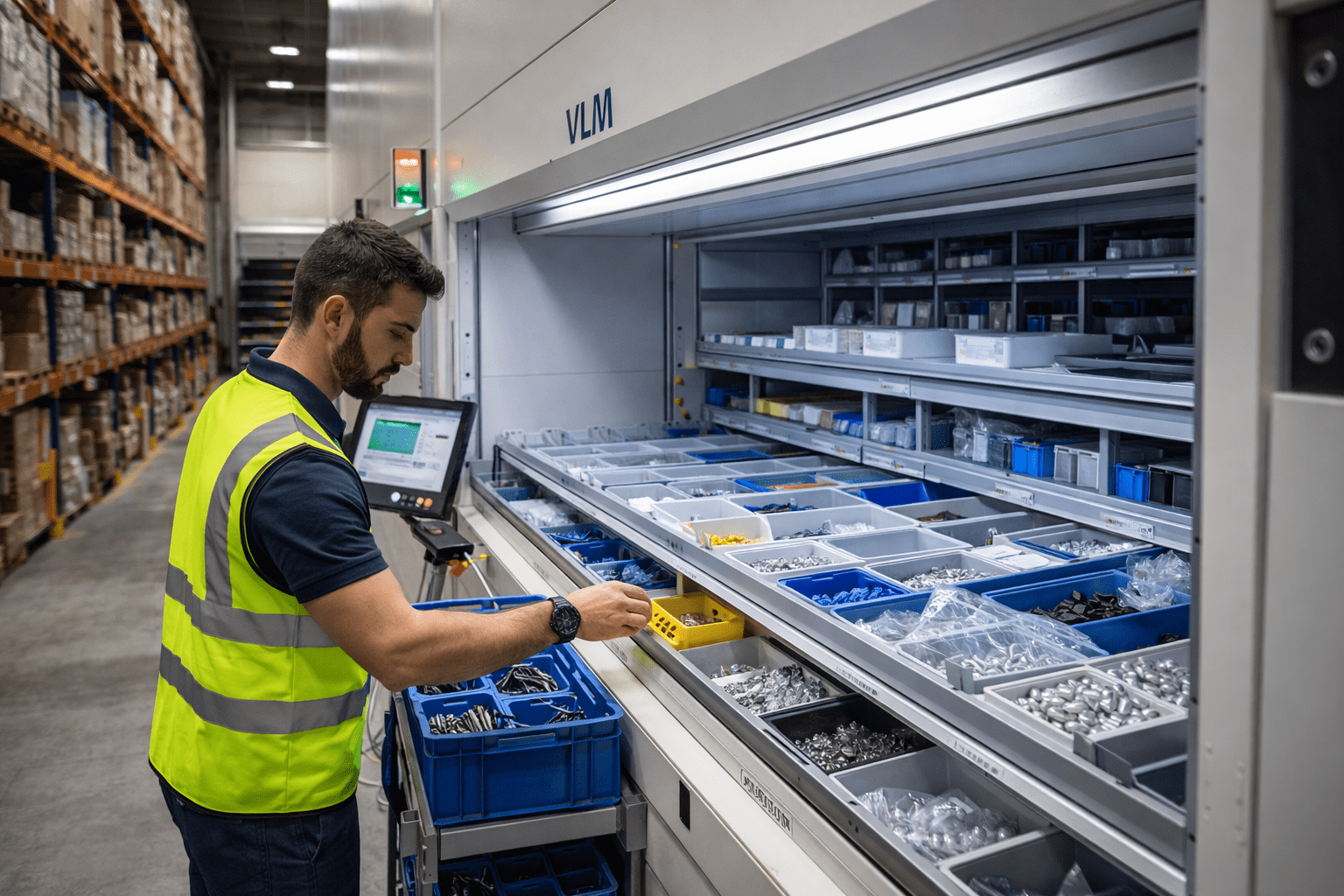
When small parts are distributed across long shelving runs, vertical storage offers a way to consolidate inventory and bring items directly to the operator. By using vertical height instead of floor space, these systems dramatically reduce walking and improve ergonomics.
Many operations begin evaluating this approach by reviewing broader storage solutions and warehouse storage solutions before narrowing their focus to vertical systems. For small-parts environments, vertical lift modules are frequently considered because they support dense storage, access control, and faster pick cycles.
Cost is often a deciding factor, which is why pricing resources like vertical lift module price become part of the decision-making process. When implemented correctly, vertical storage can significantly increase picks per hour while freeing floor space for other operations.
Stabilize throughput with automation when labor becomes the constraint
When labor availability or consistency becomes unpredictable, automation can help stabilize output without continuously adding headcount. Depending on the operation, this may include automated vertical storage, goods-to-person workflows, or more advanced systems.
Many facilities begin this evaluation through automated warehousing solutions, then expand into options such as storage robots or higher-throughput AS/RS systems. Automation works best when layered on top of solid processes rather than used as a substitute for them.
When the underlying workflow is optimized, automation amplifies efficiency instead of masking inefficiencies.
Track the right metrics to sustain improvements
To ensure gains in warehouse picking last, teams need to measure the metrics that actually reveal bottlenecks. Picks per labor hour is important, but it should be viewed alongside travel time, exception rates, accuracy, and order cycle time.
These metrics are often reviewed as part of ongoing warehouse operations and efficiency initiatives or broader evaluations of how to run an efficient warehouse. When data highlights where time is truly being lost, improvement efforts become more targeted and effective.
Increase picks per hour without expanding your footprint
Raising picks per hour doesn’t require pushing people harder or expanding the building. It requires better flow, smarter storage, and fewer interruptions. Whether the next step is re-slotting, vertical storage, or automation, starting with a clear optimization strategy ensures every improvement delivers real results.
For many operations, reviewing existing warehouse optimization resources is the most effective first step before committing to larger system changes. When inefficiencies are removed at the process level, technology investments become far more impactful—and picks per hour increase without adding headcount.
Frequently Asked Questions (FAQ’s)
What is a good picks-per-hour benchmark for a warehouse?
Picks per hour varies widely by operation, order profile, and picking method. Manual piece-picking operations often range from 60–120 picks per hour, while optimized workflows with batch picking, pick-to-light, or goods-to-person systems can exceed that significantly.
Why does walking time matter more than picker speed?
In most warehouses, travel time consumes more labor than the physical act of picking. Reducing walking through better slotting, layout design, and inventory consolidation typically improves picks per hour more than asking employees to work faster.
How often should fast-moving SKUs be re-slotted?
High-velocity SKUs should be reviewed regularly, often quarterly or seasonally. As demand patterns change, keeping fast movers close to pack-out areas and at ergonomic heights helps maintain consistent pick rates.
When does batch picking make sense?
Batch picking works best in environments with high order overlap, small item counts, and predictable order profiles. It is less effective for large, single-order picks or operations with highly variable SKUs.