
Warehouse managers face mounting pressures in 2026: labor shortages, skyrocketing e-commerce demands, and sustainability mandates. Staying ahead means embracing warehouse optimization trends like AI-driven automation, robotics-as-a-service (RaaS), and intelligent software orchestration that deliver up to 40% productivity gains and 30% cost reductions. This guide breaks down the top trends shaping efficient, scalable operations, drawing from 2025’s real-world lessons to help you future-proof your facility with proven strategies from Vertical Storage USA.
AI-Driven Demand Forecasting and Inventory Management Takes Center Stage

AI has evolved from experimental tool to essential backbone for warehouse optimization, powering real-time demand predictions that prevent stockouts and overstocking. In 2025, 45% of companies integrated machine learning for forecasting, with nearly 50% expanding AI across inventory and supply chain functions. By analyzing sales channels, seasonal patterns, and external signals, AI achieves 99% inventory accuracy, slashing costs by 30% and boosting productivity by 40%.
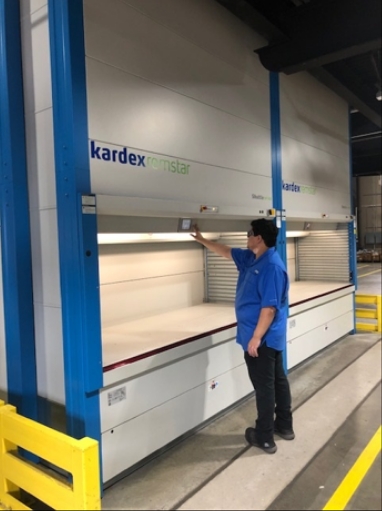
Vertical Storage USA specializes in vertical lift modules (VLMs) and automated storage systems that pair seamlessly with AI platforms. These solutions maximize space in high-SKU environments, turning data insights into actionable storage decisions. For instance, AI-recommended replenishment timing minimizes pick interruptions, a shift expected to become standard in warehouse management systems (WMS) and warehouse execution systems (WES) by mid-2026.
Key benefits include:
- Real-time alerts for low stock, reducing emergency restocking.
- Optimized slotting that adapts to demand surges.
- 72% drop in mispick-related returns through hyper-intelligent picking validation using computer vision.
Early adopters report 15-30% better space utilization when combining AI with digital twins – virtual simulations that test layouts without disrupting operations.
Robotics-as-a-Service (RaaS) Democratizes Automation Access
Gone are the days of massive upfront investments locking warehouses into rigid hardware. RaaS flips the script, offering subscription-based robotics that scale with demand, deploy 3-5x faster, and treat automation as an operational expense. This trend exploded in 2025, making advanced tech viable for mid-sized operations facing high-mix SKU challenges.
RaaS providers handle maintenance, upgrades, and software integration, freeing teams to focus on throughput. Results? Faster ROI and flexibility for seasonal peaks. Autonomous mobile robots (AMRs) under RaaS models cut walking time by up to 50%, transporting totes and pallets without manual intervention.
| RaaS vs. Traditional Automation | RaaS | Traditional |
|---|---|---|
| Deployment Time | Weeks | Months |
| Cost Model | Subscription | CapEx |
| Scalability | On-demand | Fixed |
| Maintenance | Provider-managed | In-house |
Integrate RaaS with solutions from Vertical Storage USA for hybrid setups where robots feed directly into vertical storage, enhancing overall warehouse automation trends efficiency.
Software Orchestration Outpaces Hardware in Flexibility
Hardware remains vital, but software-defined warehouse optimization is the 2026 game-changer. Warehouse Execution Systems (WES) act as the “central nervous system,” unifying AS/RS, conveyors, AMRs, and IoT for real-time orchestration. This shift shrinks deployment from months to weeks, enabling instant workflow tweaks for SKU spikes or layout changes.
In 2026, 61% of warehouses plan software investments for automated analytics and decision-making, turning frontline data into predictive intelligence. AI within WES optimizes task allocation, pick paths, and labor balancing, while low-code tools integrate ERP and WMS effortlessly.
Practical wins:
- Predictive maintenance via AI and IoT sensors cuts unplanned downtime by 70%.
- Granular metrics control for 32% higher worker retention through human-machine collaboration.
- Cloud-based reconfiguration without new hardware.
Legacy systems like static racking are out; modular robotic AS/RS and AI sorters are in, replacing pick modules with dynamic, responsive designs.
Human-Machine Collaboration for Resilient Operations

Full automation sounds appealing, but 2026 emphasizes cobots and wearables augmenting human workers amid staffing gaps and seasonality. Collaborative systems reduce injury risks, speed onboarding, and maintain output during turnover.
Vision systems emerge as quality gates, instantly verifying labels, dimensions, and packaging to slash outbound errors. Wearables provide hands-free guidance, while cobots handle repetitive lifts, yielding 80% safer cold storage via robotic access.
Zebra’s 2025 Warehouse Vision Study shows 65% of digitized warehouses pursuing AI software for workflows and maintenance, with 57% adopting machine learning for pattern recognition. This hybrid approach ensures stability, especially in high-volume peaks.
Inbound and Micro-Fulfillment Automation Addresses Space Crunch
Outbound fulfillment dominated past years, but inbound automation leads 2026 investments: robotic de-palletizing, AI vision inspection, and AMRs for case transport. Native case handling with auto-traying cuts touches, accelerating flow from dock to shelf.
Urban space shortages fuel micro-fulfillment: high-density AS/RS compresses SKUs, boosting capacity 200-300% without expansion. Vertical solutions shine here, retrieving stock faster for same-day delivery.
Vertical Storage USA excels in these compact systems, integrating with inbound robotics for seamless scalability. Pair with zero-touch returns processing – automated evaluation and restocking – to eliminate manual sorting chaos and cut processing time.
Sustainability and Predictive Maintenance Build Long-Term Efficiency
2026 warehouses prioritize green optimization: renewable energy, efficient lighting, and low-emission automation. Predictive maintenance using AI/IoT monitors equipment in real-time, extending lifespans and reducing breakdowns by 30-50%.
Agentic AI – autonomous agents handling procurement and scheduling – cuts material travel time 30-40%. Data-driven orchestration via IoT enables adaptive slotting and dashboards for transparency.
Market data underscores urgency: AS/RS holds 30.5% share, with mobile robots growing at 20.5% CAGR to 2030. Robotics market hits $21B by 2030.
Change Management: The Unsung Hero of Optimization Success
Tech alone fails without culture. 2026 demands change management to train teams on AI tools, RaaS fleets, and WES platforms. Start with data cleanup and pilot modular automation like mobile systems for quick wins.
Top priorities:
- Flexible orchestration platforms.
- Inbound visibility focus.
- AI/RaaS for agility.
Frequently Asked Questions (FAQ’s)
What are the biggest warehouse optimization trends in 2026?
The biggest trends include AI-driven demand forecasting, robotics-as-a-service (RaaS), software-led warehouse orchestration, human-machine collaboration, inbound automation, micro-fulfillment, and predictive maintenance.
How is AI changing warehouse operations in 2026?
AI enables real-time demand forecasting, adaptive slotting, predictive maintenance, and intelligent task orchestration, helping warehouses reduce costs, improve accuracy, and respond faster to demand changes.
What is Robotics-as-a-Service (RaaS) and why is it growing?
RaaS allows warehouses to deploy robots through subscription models instead of large capital investments. It offers faster deployment, flexible scaling, and lower financial risk compared to traditional automation.
Why is software orchestration more important than hardware in modern warehouses?
Software platforms like WES coordinate robots, automation, and labor in real time, allowing warehouses to adjust workflows quickly without replacing physical equipment.
Preparing Your Warehouse for Peak Performance in 2026 and Beyond
Implement these 2026 warehouse optimization trends now to outpace competitors: audit your WMS for AI readiness, pilot RaaS AMRs, and explore vertical storage upgrades at Vertical Storage USA. Facilities blending software intelligence, collaborative robotics, and space-efficient systems report 70% safer environments, 99.9% stock accuracy, and unmatched agility. Contact Vertical Storage USA today to schedule a consultation – transform challenges into competitive edges before peak season hits.